
Prime Minister Narendra Modi on Thursday left for the Uzbek city of Samarkand to attend the Shanghai Cooperation Organisation (SCO) summit that will also see the participation of Russian President Vladimir Putin, Chinese President Xi Jinping and Iran's Ebrahim Raisi among other top world leaders.

At a joint media briefing with Lavrov, Jaishankar listed issues such as "factors of instability" such as terrorism and its cross-border manifestation and said it remains a "major concern".

The G20's Bali Declaration Wednesday acknowledged differences among members on the Russia-Ukraine war but said it was essential to adhere to international law, including protection of civilians caught in conflicts.
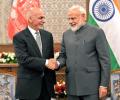
The two leaders 'shared perspectives on situation in Afghanistan, including the role played by India towards an inclusive peace process', he said.

Modi, who met Putin last week on the sidelines of the 22nd meeting of the Shanghai Cooperation Organization in Uzbekistan's Samarkand, had told the Russian leader that "today's era is not of war".

Atmar briefed Jaishankar about the situation in the war-torn country amid growing security concerns over the Taliban fighters rapidly seizing control of a large number of areas, forcing many countries to scale down their presence there.

PCB chief Najam Sethi said that they had sent a proposal to ACC that India can play their matches at a neutral venue.

His trip to Moscow comes days after Defence Minister Rajnath Singh visited the Russian capital to attend a meeting of the defence ministers of the eight-nation SCO of which both India and China are members.

'Both Russia and the USA seek New Delhi's friendship, because for both -- Russia and the USA -- India is a certain counterbalance to China.'

In a significant policy statement on the Taliban which is making big gains in its offensive in Afghanistan, China has asked it to make a "clean break" from all terrorist forces, especially the Al Qaida-backed Uyghur Muslim militant group ETIM fighting for the volatile Xinjiang province's independence.

China on Tuesday announced that its Defence Minister General Li Shangfu will visit India this week to attend the meeting of SCO defence ministers from April 27 during which he is expected to hold talks with his Indian counterpart Rajnath Singh on ending the prolonged eastern Ladakh standoff which has severely strained bilateral ties.
'India needs to closely monitor the discussions at the UNSC and make counter-measures as this touches its core interests', points out Srikanth Kondapalli.
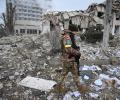
Reconstruction efforts after the Russia-Ukraine war will be dominated by the heft of the membership of major nations across international organisations. India is hamstrung because it does not play host to any major global institution nor does it hold positions of significant influence in the ones in which it has membership. As a result, the world's sixth largest economy is obliged to follow the rules set by most of them.

Prime Minister Narendra Modi on Friday pushed Russian President Vladimir Putin to end the conflict in Ukraine, saying 'today's era is not of war' even as he called for finding ways to address the global food and energy security crisis.

Chinese Foreign Minister Wang Yi arrived in India Thursday evening in the highest-level visit between the two countries after the ties came under severe strain following the eastern Ladakh standoff nearly two years ago.
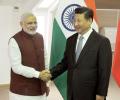
China on Thursday said its stand on blocking India against UN action on Pakistan was based on "facts" and in the spirit of "objectiveness and fairness".
"Prime Minister Modi has a powerful, influential voice on the world stage. We know the Russian leadership respects India's voice and position on the world stage. I think Prime Minister Modi's intervention is very, very welcome. And we really hope that Vladimir Putin listens to those voices who are calling for peace and for de-escalation. So we very much welcome Prime Minister Modi's intervention," Cleverly told PTI in an interview.

"Terrorism is an enemy of the basic human rights: of life, peace and prosperity," Swaraj said.

India as the G20 host has a 'unique role' to play in bringing about an end to the war in Ukraine due to its 'longstanding historical' ties to Russia, the United States has said, expressing hope to work closely with New Delhi to find a way to stop the conflict.

His remarks without naming any country came against the backdrop of tension between India and Pakistan after New Delhi revoked Jammu and Kashmir's special status.

It is the first highest level face-to-face meeting between the two sides after the border row escalated in eastern Ladakh in early May.

'The Indian version is that the two top diplomats merely exchanged pleasantries, while the Pakistani side characterised the encounter as an 'informal dialogue'.' 'The truth, as always in such piquant situations, is somewhere in between.' 'It stands to reason that ice has been broken,' says Ambassador M K Bhadrakumar.

Prime Minister Modi told President Xi that he has made efforts to improve ties with Islamabad but these efforts have been "derailed".

If China's behaviour in the past on ticklish issues is any indication then China could eventually support India's NSG application, says Rup Narayan Das.

'Happily,' says Ambassador B S Prakash, 'BRICS displayed new-found energy and built something real, a bank. Between needless nihilism and as yet unjustified euphoria, there are many stations for the BRICS train and we can watch its progress with renewed interest.'

Russia and the US began second round of negotiations on securing Syria's chemical arsenal, hoping the high-stakes talks would lead to broader peace efforts, even as Damascus submitted application to UN for joining the chemical weapons convention.

Terrorism and Afghanistan were the focus points of Prime Minister Narendra Modi's talks with Uzbek President Islam Karimov on his first visit to Central Asia.
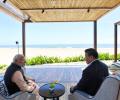
'India's relationship with China has been and will continue to be complex, delicate and sensitive,' says Rup Narayan Das.
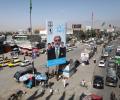
As Afghans head to the polling booths to elect a new president, a contested and fraud-marred elections could potentially throw Afghanistan into a renewed cycle of violence and instability, says Dr Shanthie Mariet D'Souza.

'While economic ties are making incremental progress, it is in the security and strategic domains that the India-Japan synergy is more compelling,' says Dr Rajaram Panda.
 © 2026 Rediff.com - Advertise with us - Disclaimer - Privacy Policy - Sitemap - Feedback - About us - Terms of use - Grievances